Introduction
Anti tank obstacles have been a critical component of military defensive strategy for nearly a century. From the dragon teeth fortifications of World War II to modern steel tank traps used to protect forward operating bases, these barriers are designed to stop, delay, or channel armored vehicles. Understanding the different types of anti tank obstacles, their materials, costs, and effectiveness is essential for military planners, defense contractors, and security professionals.
This comprehensive guide compares the three primary categories of anti tank obstacles: steel tank traps, dragon teeth barriers, and Czech hedgehog structures. You will learn how each type works, what materials and dimensions are involved, how much they cost to manufacture, and where to buy them for military use. Whether you are designing a perimeter defense system or evaluating options for a new deployment, this article provides the technical and practical information you need.
What Is an Anti Tank Obstacle?
An anti tank obstacle is any structure or device designed to stop, delay, or destroy armored fighting vehicles, particularly main battle tanks. Unlike simple barriers meant to stop light vehicles, anti tank obstacles must withstand enormous force — a modern battle tank can weigh 60–70 tons and generate over 1,500 horsepower. Anti tank obstacles work through three primary mechanisms: physical blocking (preventing the vehicle from passing), tipping or destabilization (causing the vehicle to roll or become stuck), and channeling (funneling vehicles into kill zones).
Materials Used in Anti Tank Obstacles
The materials used to make anti tank obstacles vary depending on the type and intended permanence:
- Steel: The most common material for modern portable anti tank obstacles. High-strength steel (typically ASTM A36 or military-grade armor plate) provides durability and can be fabricated into various shapes. Steel tank traps typically weigh 300–800 kg depending on design.
- Reinforced Concrete: Used for permanent dragon teeth and other fixed barriers. Concrete obstacles are cheaper in raw material cost but are immobile once set.
- Steel-Reinforced Concrete: Combines the compressive strength of concrete with the tensile strength of steel rebar for maximum durability.
- Railroad Rails and Scrap Steel: Improvised anti tank obstacles that can be fabricated quickly in wartime from available materials.
How Anti Tank Obstacles Work
The working principle of an anti tank obstacle depends on its design. Dragon teeth are pyramid-shaped concrete blocks that cause a tank to belly up — the vehicle climbs over the first row but its hull gets caught between the teeth. Steel tank traps use angled steel beams to create a wedge that lifts the tank tracks off the ground. Czech hedgehog barriers, made from three intersecting steel beams, are designed to roll under the tank and jam its tracks. Each type exploits specific vulnerabilities in tank design.
Types of Anti Tank Obstacles
There are several distinct types of anti tank obstacles, each with unique design characteristics and tactical applications. Understanding the differences between them is crucial for selecting the right barrier for a specific defensive requirement.
Dragon Teeth Tank Traps
Dragon teeth are pyramid-shaped concrete blocks typically arranged in multiple rows. Each tooth stands approximately 90–120 cm tall with a square base that tapers to a blunt point. They were famously deployed across the Siegfried Line and Atlantic Wall during World War II. The dragon teeth tank trap design relies on mass and spacing — teeth are positioned in staggered rows so that a tank attempting to cross will have its hull caught between adjacent teeth, immobilizing it. Modern dragon teeth are often made with reinforced concrete and steel rebar for enhanced durability.
Czech Hedgehog Barriers
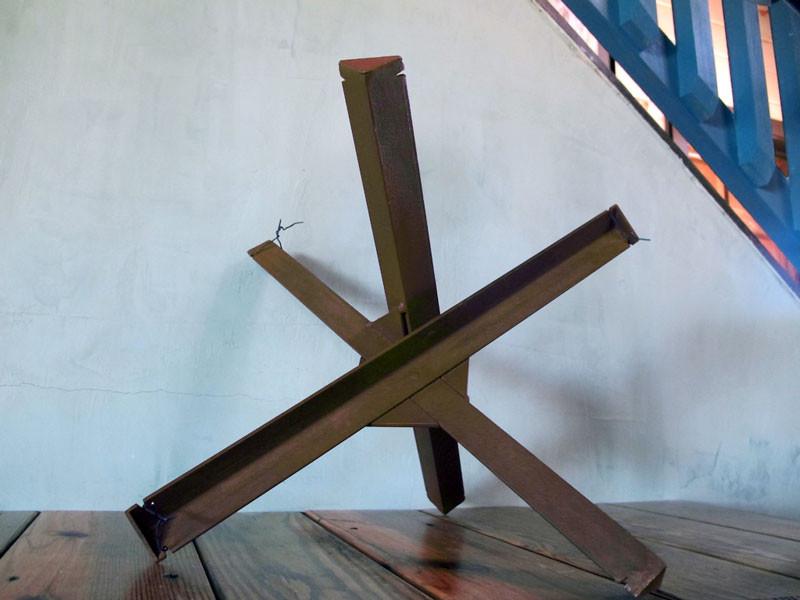
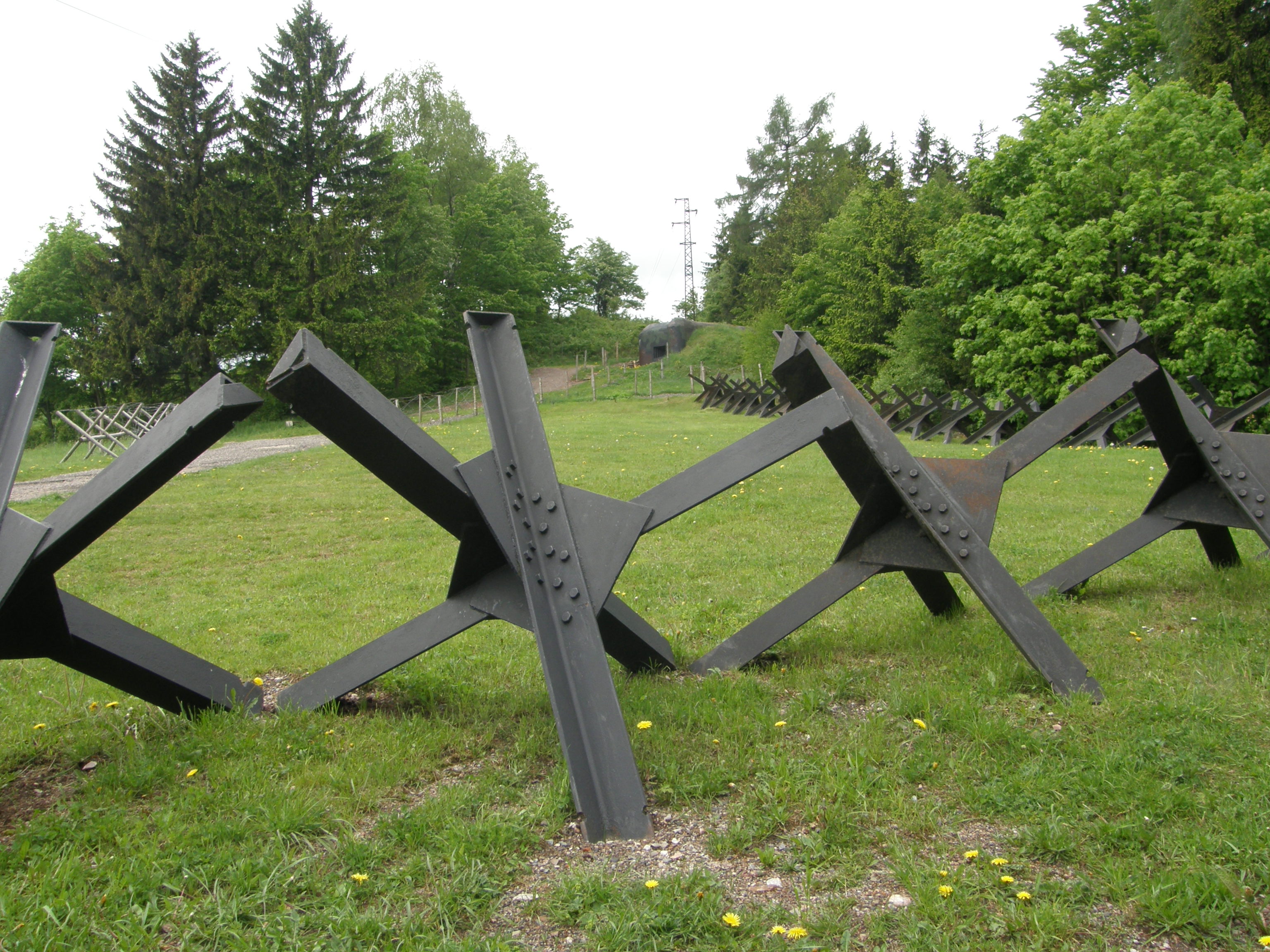
The Czech hedgehog military barrier consists of three steel beams or rails welded together at their centers to form a three-dimensional star or jack shape. Each leg is typically 1.5–2 meters long. When deployed, the hedgehog is effective regardless of orientation — at least one leg will always point upward to engage an approaching vehicle. The difference between dragon teeth and Czech hedgehog tank traps is significant: Czech hedgehogs are portable, made of steel, and can be moved and repositioned, while dragon teeth are permanent concrete structures.
Steel Tank Traps
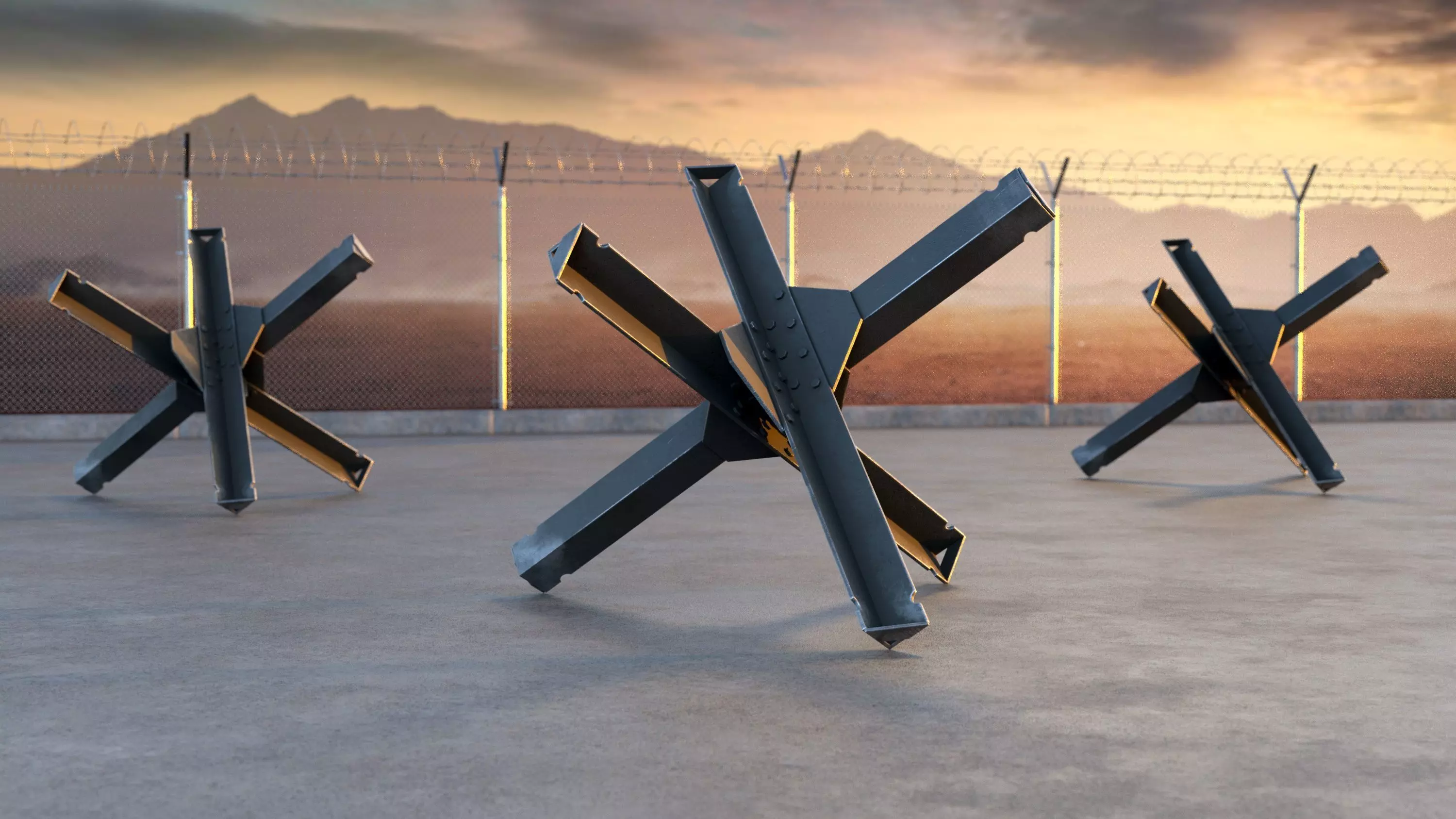
Modern steel tank traps are fabricated from heavy steel sections, often I-beams or H-beams, welded into angled configurations. A steel tank trap is a prefabricated barrier that can be rapidly deployed at checkpoints, base perimeters, and border crossings. Unlike concrete obstacles, steel traps are transportable, stackable, and can be repaired with standard welding equipment. They are the preferred choice for modern military forces that need mobile, reusable anti tank obstacles.
Steel Tank Trap Design and Manufacturing
Modern steel tank traps are precision-engineered barriers designed for rapid deployment and maximum stopping power. Understanding how these anti tank obstacles are designed, the steel specifications involved, and proper welding techniques is essential for anyone involved in their procurement or fabrication.
Standard Dimensions of a Steel Tank Trap
The typical steel tank trap measures approximately 1.5 m wide × 1.5 m tall × 1.5 m deep, forming a tripod or tetrahedral shape. The standard dimensions of a steel tank trap are standardized to ensure effectiveness against a range of military vehicles:
| Dimension | Typical Value | Notes |
|---|---|---|
| Height | 1.2–1.8 m | Must exceed vehicle ground clearance |
| Width | 1.2–1.5 m | Must span track width |
| Steel beam size | 150–300 mm I/H-beam | Based on required load rating |
| Weight | 300–800 kg | Varies with beam size and design |
What Type of Steel Is Used for Tank Traps?
The type of steel used for tank traps is a critical design decision. Most steel tank traps are fabricated from structural steel grades such as ASTM A36, S355JR, or military-grade armor plate. For heavy-duty applications, high-strength low-alloy (HSLA) steel with yield strengths above 350 MPa is recommended. The steel must be weldable, impact-resistant at low temperatures, and corrosion-resistant if deployed in harsh environments. Some manufacturers offer galvanized or weather-resistant steel options for extended field life.
Welding a Steel Tank Trap Properly
To weld a steel tank trap properly, certified welders must follow military-grade fabrication standards. Common techniques include fillet welding at full penetration on all beam joints, using E7018 electrodes for structural integrity. Weld inspection should include ultrasonic or X-ray testing for load-bearing joints. A poorly welded steel tank trap can fail catastrophically under the impact of a 60-ton tank, making quality control essential.
The weight of a typical steel tank trap depends on beam dimensions: a trap made from 200 mm I-beam weighs approximately 450 kg, while one using 300 mm beams can exceed 750 kg. This weight is designed to prevent easy manual displacement while remaining transportable by forklift or trailer.
Dragon's Teeth Tank Traps: History and Modern Effectiveness
Dragon\u0027s teeth are one of the most recognizable anti tank obstacles in military history. A dragon\u0027s teeth tank trap is a pyramid-shaped concrete barrier designed to stop armored vehicles by causing them to belly up on the obstacle. These barriers were used extensively during World War II and remain relevant today for permanent defensive installations.
World War II Usage
Dragon\u0027s teeth tank traps were a defining feature of 20th-century defensive lines. German forces deployed over 500,000 dragon\u0027s teeth along the Siegfried Line (Westwall), and similar obstacles were used on the Atlantic Wall. Dragon\u0027s teeth were typically arranged in five rows — four staggered rows of progressively taller teeth followed by a final row designed to trap tanks that made it through. The dragon\u0027s teeth tank trap of WW2 was made from reinforced concrete poured into wooden forms. Individual teeth were 1–1.5 m tall with a square base approximately 2 m across. They were spaced 2–3 m apart depending on the tactical requirement. How to build dragon\u0027s teeth tank traps in WW2 involved site preparation, rebar reinforcement cages, wooden form construction, and concrete pouring with curing times of several weeks.
Effectiveness Against Modern Vehicles
The effectiveness of dragon\u0027s teeth tank traps against modern vehicles is a subject of debate among military engineers. While modern main battle tanks like the M1 Abrams and Leopard 2 have significantly more power and advanced suspension systems, properly constructed dragon\u0027s teeth remain a formidable obstacle. Modern countermeasures include specialized engineering vehicles that can breach or demolish concrete barriers, but this takes time and exposes the vehicle to enemy fire. For permanent border defenses, dragon\u0027s teeth are still specified in many military engineering manuals because they are inexpensive to produce (concrete costs approximately $100–$200 per cubic meter) and require no ongoing maintenance once set.
How much do dragon\u0027s teeth tank traps cost to manufacture? The cost to manufacture dragon\u0027s teeth tank traps ranges from $200–$600 per tooth depending on size, reinforcement requirements, and local concrete prices. A typical defensive line requiring 500 teeth would cost $100,000–$300,000 in materials alone, plus site preparation and installation labor. Compared to steel alternatives, concrete dragon\u0027s teeth are more economical for permanent, large-scale defensive installations.
How Effective Are Anti Tank Obstacles Against Modern Tanks?
Understanding how effective anti tank obstacles are against modern tanks is crucial for defense planners allocating resources. The answer depends on the obstacle type, the specific vehicle, and the tactical context.
Modern Tank Capabilities
Modern main battle tanks such as the M1A2 Abrams, Leopard 2A7, and T-90M feature advanced suspension systems, high ground clearance (40–50 cm), and powerful engines producing 1,200–1,500 horsepower. These capabilities make them more capable of overcoming obstacles than their WWII-era predecessors. However, the physical principles that make anti tank obstacles effective still apply: a tank must transfer its weight through its tracks, and if the tracks lose contact with solid ground, the vehicle becomes immobile.
Effectiveness by Obstacle Type
Steel tank traps are highly effective against modern tanks because the steel structure focuses the vehicle weight on a small contact area, penetrating the track or damaging road wheels. A properly designed steel tank trap can stop a 70-ton MBT. Dragon teeth remain effective if the concrete is reinforced and the teeth are tall enough — modern tanks may be able to push over single rows, but multiple staggered rows will defeat most attempts. Czech hedgehog barriers are effective as anti-tank obstacles because their random orientation upon deployment makes them unpredictable — at least one leg always points upward to engage the vehicle underbelly.
What is the difference between tank traps and anti tank obstacles? All tank traps are anti tank obstacles, but not all anti tank obstacles are tank traps. "Tank trap" typically refers to a device designed to physically trap or immobilize a specific vehicle, while "anti tank obstacle" is a broader category encompassing barriers, ditches, minefields, and terrain modifications.
Cost Comparison: Steel Tank Traps vs Dragon Teeth vs Czech Hedgehogs
Cost is a major factor in selecting anti tank obstacles for a defense project. Below is a detailed cost comparison of steel tank traps, dragon teeth, and Czech hedgehog barriers.
| Obstacle Type | Unit Cost (USD) | Installation Cost | Lifespan | Portability |
|---|---|---|---|---|
| Steel Tank Trap | $800–$2,500 | Low (drop in place) | 15–25 years | High |
| Dragon Teeth (Concrete) | $200–$600 | High (pouring/curing) | 50+ years | None |
| Czech Hedgehog | $400–$1,200 | Low (drop in place) | 15–20 years | High |
Steel Tank Trap Cost
How much does a steel tank trap cost? The price of a steel tank trap ranges from $800 to $2,500 per unit depending on steel grade, beam size, corrosion protection, and fabrication complexity. For bulk orders of 100+ units, prices typically drop to $600–$1,800 per trap. The cost to manufacture an anti tank obstacle made of steel is driven primarily by raw material costs — structural steel currently runs $700–$1,200 per ton. A typical 450 kg trap requires approximately $350–$550 worth of steel plus fabrication labor.
Dragon Teeth Cost
Dragon teeth are the most economical anti tank obstacle for permanent installations. At $200–$600 per tooth, they offer a low material cost. However, installation requires formwork, concrete pouring, curing time, and skilled labor, which can double the effective cost.
Czech Hedgehog Cost
Czech hedgehog barriers are intermediate in cost at $400–$1,200 per unit. They offer a good balance of portability, effectiveness, and affordability, making them popular for military forces needing mobile anti tank obstacles that can be repositioned as tactical situations evolve.
How to Design Anti Tank Obstacles for Military Use
Designing effective anti tank obstacles for military use requires understanding vehicle dimensions, terrain conditions, and the specific threat level. Military engineers follow established principles to create obstacles that cannot be easily bypassed or destroyed.
Key Design Considerations
To design an anti tank obstacle for military use, engineers must consider:
- Vehicle Profile: The obstacle must exceed the ground clearance of the target vehicle (typically 40–50 cm for modern MBTs) and must be wide enough to span the full track width.
- Arrangement: Obstacles are rarely deployed singly. Staggered rows, multiple layers, and interlocking patterns prevent vehicles from finding a path through.
- Terrain Integration: Natural obstacles such as steep slopes, water bodies, and forested areas should complement man-made anti tank obstacles.
- Bypass Prevention: Flanking routes must be blocked or covered by fire to prevent vehicles from simply driving around the obstacle.
- Materials and Durability: The design must account for the local climate — extreme temperatures, humidity, and corrosion affect steel obstacles, while freeze-thaw cycles affect concrete.
Design Standards and Ratings
Modern anti tank obstacle design follows military specifications such as MIL-STD and NATO standardization agreements (STANAG). These standards define minimum dimensions, material grades, load ratings, and testing protocols. For example, a steel tank trap designed to stop a 70-ton vehicle must withstand a static load of at least 700 kN and a dynamic impact load significantly higher. Finite element analysis (FEA) is commonly used to optimize the geometry of steel tank traps for maximum strength-to-weight ratio.
Integration with other defensive elements is also critical. Anti tank obstacles are most effective when combined with anti-personnel barriers, observation posts, and direct fire positions. The overall defensive scheme should create a layered approach where anti tank obstacles slow the advance, allowing anti-tank guided missile (ATGM) teams and artillery to engage targets at optimal ranges.
Where to Buy Steel Tank Traps and Anti Tank Obstacles
Knowing where to buy steel tank traps and anti tank obstacles is essential for military procurement officers and defense contractors. Several established manufacturers and suppliers serve the global defense market.
Reputable Manufacturers
When looking for anti vehicle barrier manufacturers and steel tank trap suppliers, consider companies with proven track records in military-grade fabrication. Leading manufacturers include specialized defense steel fabricators that offer certified welding, quality control documentation, and compliance with military standards. When evaluating suppliers, check for ISO 9001 certification, military specification compliance, and references from defense clients.
Procurement Considerations
Before purchasing anti tank obstacles, consider the following factors:
- Certification: Ensure the manufacturer provides material certifications, weld procedure specifications (WPS), and proof of load testing.
- Shipping and Logistics: Steel tank traps are heavy — a 40-foot container can hold approximately 12–20 traps depending on design. Factor in shipping costs, customs clearance for international orders, and last-mile delivery to the deployment site.
- Custom Design: Many reputable manufacturers offer custom design services to adapt standard steel tank traps to specific threat scenarios, terrain conditions, or integration requirements.
- After-Sales Support: Look for suppliers that provide installation guidance, maintenance manuals, and spare parts availability.
The global market for anti tank obstacles is competitive, with manufacturers in North America, Europe, and Asia offering various designs. Requesting quotes from multiple suppliers and comparing total cost of ownership — including shipping, installation, and lifespan — will ensure the best value for your defense budget.
Conclusion
Choosing the right anti tank obstacle depends on your specific operational requirements, budget, and deployment timeline. Steel tank traps offer the best combination of portability, effectiveness, and rapid deployment for modern military forces that need flexible defensive solutions. Dragon teeth remain the most cost-effective option for permanent, large-scale defensive lines where mobility is not required. Czech hedgehog barriers provide a practical middle ground and have proven their value across decades of military use.
When selecting anti tank obstacles for your defense project, consider the total cost of ownership — not just the unit price but also installation, maintenance, and eventual removal. Work with certified manufacturers who can provide documentation, testing, and after-sales support. Whether you need 50 steel tank traps for a forward operating base or 5,000 dragon teeth for a national border, understanding the differences between these obstacle types is the first step toward an effective defensive strategy.
For more information on steel tank traps, Czech hedgehogs, and other anti tank obstacles, or to request a quote for your specific requirements, contact our team of defense barrier specialists.